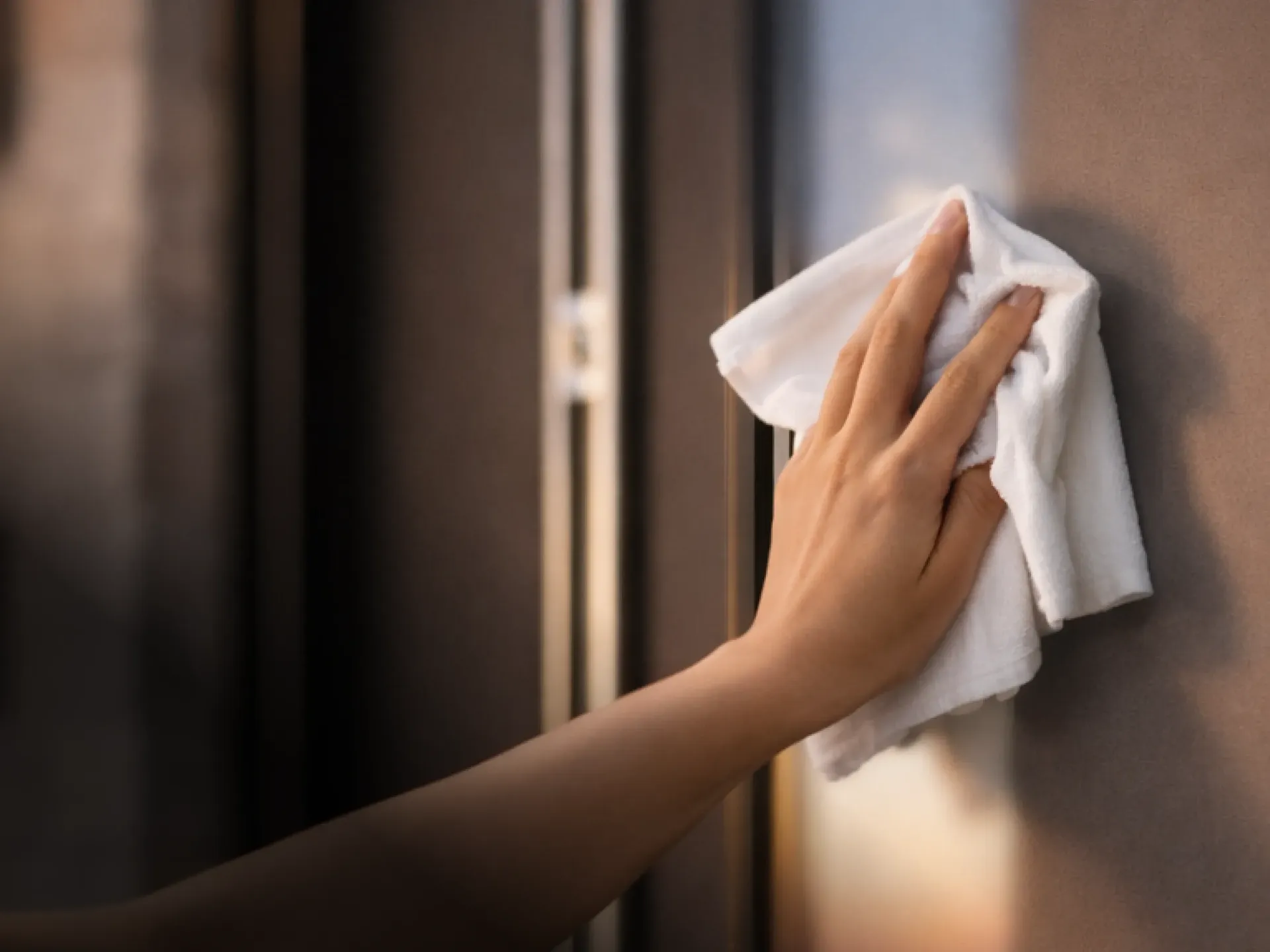
Care and Maintenance
USEFUL TIPS
Regular care and maintenance for flawless door operation
For a long lifespan and reliable operation, entrance doors must be regularly maintained and cared for. They are exposed daily to various influences, temperature changes, dust, and dirt.
Lubricating the lock
Lubricate the moving parts of the hardware and the cylinder at least twice a year with acid-free oil or grease. Regularly check the hardware for tightness and wear.
Adjusting
the sash
Periodically check if the door closes smoothly, whether it fits evenly against the seals, and that the gaps are as uniform as possible. Any deviations in the position of the sash can be corrected by adjusting the hinges.
Care for
seals
Clean the seals once a year with a mild detergent and coat them with a silicone spray for better sealing and a longer lifespan.
Cleaning the
door sash
At least once a year, clean the sash and the frame with lukewarm water, a little soapy water, and a soft cloth or sponge. For visible dirt, such as after construction work, first rinse the door with water to remove larger and more stubborn particles. Avoid abrasive agents.
Closing the
door
With mechanical locks, the door must always be fully locked to ensure effective sealing and security.
Pirnar
Detailed recommendations for door maintenance
Aluminium front doors are low maintenance, but thorough cleaning of ALU surfaces is essential to maintain the decorative appearance of the surface and reduce the risk of corrosion. Thorough cleaning with mild, pH-neutral or alkaline cleaners twice a year is sufficient. Cleaning is quick and very easy, although it is essential to use a microfibre cloth so as not to damage the surface treatment. You can also use a range of cleaning and care products that you can order from an authorised dealer or the Pirnar company.
Care of powder-coated aluminium surfaces
The door frame and door leaf need to be cleaned at least once a year or several times if subjected to heavy environmental impact. Clean with cold water, add a little soap or a mild detergent and wash by hand with a soft cloth or sponge. Do not use harsh, abrasive, acidic or strongly alkaline cleaning agents and scourers that will damage the surfaces. Do not use cleaning agents with unknown compositions. Matte and textured coloured surfaces should not be polished.
Cleaning should not be performed in direct sunlight or at a surface temperature above 25 degrees Celsius.
Wood is a natural and living material that must be properly protected and carefully treated, otherwise it incurs damage to the surface or colour. Despite the same type of wood, certain colour differences can occur on the surface. Even if the wood is treated with a glaze, this peculiarity sometimes cannot be eliminated. We have no influence on colour differences and resulting deviations from colour samples.
Damage to the colour is also caused by external influences such as weather and construction. Seek advice from a professional on how to repair major damage. Minor damage such as scratches and small cracks can be repaired with a thin brush and water-soluble acrylic-based paint.
Maintain wooden doors once or twice a year, with maintenance intervals depending on the colour tone of the door and place of external door installation.
Restoration and maintenance of glazes
Coat the door with a protective emulsion, which closes the micro-cracks in the coating and forms a new protective layer. A simple surface touch-up will help to prolong the life span of the coating. It is important to repair the damaged area immediately, otherwise there is a risk of water penetrating the wood, which will freeze in winter and cause the coating to peel off. Damage that is repaired later can be fixed but results in higher costs.
Restoration and care of oiled surfaces
We recommend that oiled surfaces are also cleaned and maintained once or twice a year. The surfaces should be cleaned with a damp cloth and re-oiled. The surface must be dry and dust-free before oiling. Oil the surface, wait 5 minutes for the oil to be absorbed and then wipe off the excess oil with a cloth in the direction of the tree rings.
To clean the glass, use commercially available glass cleaning agents and a soft cloth that will not cause scratches or damage. First remove stubborn stains with suitable solvents such as ethanol, acetone or benzine and then rinse with water. When cleaning with solvents, make sure that the edge seal of the insulating glass, the sealant or other organic parts, such as silicone joints, do not incur damage. Do not use strongly alkaline washing lyes or acids to clean the glass, especially cleaners based on hydrofluoric acid or hydrogen fluoride. When cleaning, we recommend circular movements from top to bottom and from inside to outside. This technique ensures that the cleaning agent foams and cleans the entire glass surface well.
Stainless steel products do not require any special care, they just need to be cleaned regularly. Dust traces, soot and fingerprints are removed with a damp, soft cloth, and then wiped off with a dry cloth. For stubborn dirt such as concrete stains and plaster, you can use cleaning agents with added polish. For traces of surface rust caused by fine metal dust in the air (proximity to roads, macadam, unfinished buildings, construction sites, long-term non-maintenance ...), use a nylon cloth and water with added organic or mineral thinners. In the initial phase of surface rust, rubbing the area with a cloth in the sanding direction is sufficient. Cleaning should always be done in the same direction in which the product is sanded or finished (parallel to the structure).
Lubricate the moving parts of the hardware with acid-free grease or oil at least twice a year. This increases the life of the hardware and facilitates the functioning of the handle and cylinder insert. Also lubricate the door hinges, which are easiest to lubricate with oil spray. Use a lubricating oil (e.g. RIVOLTA TRS) to lubricate the cylinder liner. Regularly check the correct position, fastening and wear of the hardware.
To maintain functionality, clean the seals at least once a year with commercially available mild cleaning agents. Cleaning with silicone sprays is also suitable, which increases the tightness and service life of the seals.

CONTACT US
Get in touch with us
Catalogues